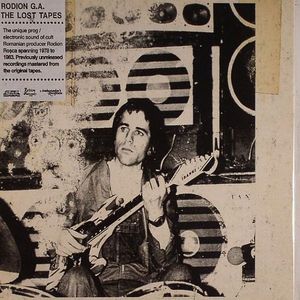
Strut, in conjunction with Ambassadors Reception and Future Nuggets, presents the first ever retrospective of fabled band Rodion G.A., one of Romania’s best kept musical secrets of the last 30 years. As a band, Rodion G.A. were a unique phenomenon in their homeland at the time, operating in their own universe during a prolific period of recording from 1978 to 1984 at a time of significant political repression under the Ceausescu regime. Bandleader, Rodion Ladislau Rosca, was an enigma. As half-Hungarian, half-Romanian, he lived near the border in Cluj, a city with a healthy music culture which had spawned important prog rock bands incuding Cromatic, Experimental Quintet and Semnal M. Despite the political conditions, a music scene existed in Romania, mainly within a network of festivals around the country and in seaside towns at restaurants and clubs.
From the start, Rodion was concerned with his own style of composition and set himself apart from the predominant rock sounds that dominated Romanian music during the late 60s. Technically and in his compositions, he was obsessed with every detail. His first sessions were recorded during 1969-1972 – simple, sparse and haunting pieces using reel to reel recorders, based around vocals, guitars and improvised drums. In 1975-6, Rosca formed Rodion G.A., the G.A. comprising band members Gicu Frca. and Adrian Cpraru. Rosca had amassed equipment and became a DIY tech wizard, improvising his own techniques of composing using reel to reels. Surrounded by three or four Tesla tape machines, he would record beats and guitar on one channel of the tape, then stop and add other instruments on the other a raw means of multi-tracking. He would use the other machines to add effects and delays on both instruments and vocals. Other tools in his armoury included an East German Vermona drum machine, a toy Casio VL Tone and a small Russian organ to which he added phaser, flanger and delay pedals. From the start, the band’s sound was incomparable to other contemporaries – dense electronic sounds, raw programmed rhythms, intricate arrangements, prog and classical touches.
Fast forward to 2012 when the myth of Rodion G.A. came to the attention of excellent Romanian production and DJ crew, Future Nuggets, a collective as dedicated to unearthing Romania’s musical past as they are forging new sounds steeped in the country’s traditions.
 The Hipodrome Of Music