Digital Gadget owner Bogger AKA Jeff Pils comes forward with a collection of straight-up electro with Panic ROM. 5 tracks on a limited cassette.

Digital Gadget owner Bogger AKA Jeff Pils comes forward with a collection of straight-up electro with Panic ROM. 5 tracks on a limited cassette.

Hats off to Jamal Moss for the tongue-in-cheek title of his latest album as Hieroglyphic Being, which is naturally another pleasingly wild, freewheeling, imaginative and out-there excursion in his now trademark style. It sees him sprint between mutant electronic jazz (‘Circumploar’), out-there analogue techno (’21 Days’), organ-rich post-beatdown chuggers (‘Foreboding Self Pleasure’), reverb-laden ambient soundscapes (‘A Dream Within a Dream’, ‘Delta Opus L’), industrial-strength dancefloor weirdness (‘The Prograde Direction’), sub-heavy lo-fi deep house (‘Black Love On An Early Sunday Morning’), sparse electronic future funk (‘Future Shocked’), and jacking, sci-fi seeped brilliance (‘The Andromeda Strain’). In other words, it’s another excellent collection from one of dance music’s genuine geniuses.

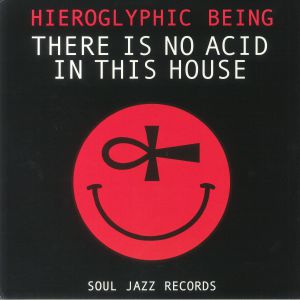
“There is no Acid in this House” is Hieroglyphic Being’s third solo album on Soul Jazz Records, a resolute and powerful statement of Jamal Moss’s raw, vital, pioneering, Afro-Futurist electronic (dance) music. Moss once-again draws upon the vast scope of experimentation that has defined Chicago’s musical universe over the last half a century – from the birth of house music with the pioneers Ron Hardy, Marshall Jefferson, Lil Louis and others to the radical avant-garde jazz legacy of the city, The Association for the Advancement of Creative Musicians, The Art Ensemble of Chicago and Sun Ra.

+/-, a modern version of the yin/yang symbol, is the title of the debut album by Avé Eva 369. It’s a nine track journey, seen through the eyes of a spirit who has landed on planet earth and makes a labyrinthine trip through its dualistic nature. Worlds of sound arise from subtle electronic textures, transitions and rhythms. Vocals overlay these worlds creating dreamscapes. The songs examine the balance and friction between opposites like heaven/hell or male/female. Avé Eva 369 embodies archetypical and mythical figures, like Eve (from Adam) and the Greek goddess Aphrodite. It’s as if these Goddesses are channeling their ancient wisdom to the artist as a form of coping with modern life. As the album gradually comes to an end, a balance between opposites is found and a long lost paradise becomes visible.

Konduku returns to the Delsin Mantis series with an exciting double pack which dives deeper into his remarkable fractured rhythms and light-touch synthesis. Over the course of nine tracks Ruben Üvez straddles the space between introspective headphone trips and hypnotising dancefloor elegance, operating in a liminal zone of fluid tempos, submerged atmospheres and pointillist beats. It’s an open-ended but clear-sighted approach that aligns perfectly with the direction of the Mantis series.

The self named LP marked the fifth album and end of the first incarnation of Bourbonese Qualk. Julian Gilbert left the group after ‘The Spike'(1986) to concentrate on writing and theatre, leaving Steven Tanza and Simon Crab who parted ways after touring in Europe in early 1986 and recording this album. Steven Tanza went on to found the group ‘The State’ and while Crab continued as Bourbonese Qualk (with the new line-up of Miles Miles,Crab and Owen If), dissolved the Recloose Organisation label and founded ‘New International’ as the outlet for future Bourbonese Qualk and Recloose Org releases.

Bourbonese Qualk’s third album “The Spike” was recorded during the period 1984-1985 and published by the Berlin based Dossier/Atonal label while Bourbonese Qualk were involved in organizing the Berlin Atonal festival. Parts of Side 2 of the album is a recording of pieces made for a dance and film performance at the Bloomsbury Theatre in London in 1985.

Night Defined Recordings welcomes Roger 23 for his first solo album in seven years. The enigmatic producer, DJ and record digger is now back at NDR with an album, which showcases the versatile musical interest of the cheerful Saarländer. Self-imposed highest demands on sound quality, complete openness to give place to various musical influences and the experience of many years of a music inhaling individual make ‘Bounds Of A Moral Principle And Established Standard Behavior‘ an album complete in itself.

Max Loderbauer’s career in music spans the last 3 decades and now in 2022, the seasoned mind voyager, is back with Petrichor. Petrichor distills the elements of Loderbauer’s work that are fundamental to the initiation of the label. With his Buchla, modular synth, and Haken fingerboard, Loderbauer’s improvised studio maneuvers dilate into imagined journeys from glacial peaks into the exosphere. This is Maxi at his most exhilarating state, morphing through bittersweet and optimistic soundscapes to bleak moments of throbbing unease – all while maintaining a sense of grace and elegance. Petrichor is a reflection of Loderbauer’s impactful trips to the mountains, and returning from these summits with an electrifying urge to paint this mighty perspective. The harmonies and melodies on the tracks simulate emotional peaks and valleys, with vibration and rhythm rooted in the foundation of the sound, as though it’s woven into the fabric of the fauna and flora.

2XLP celebrating Malka Tuti’s 7 years of Existence. The Sheva (Seven in Hebrew) compilation represents a large chunk of the sonic spectrum that is the Malka Tuti multiverse to date. From tribal to punk and from house to leftfield bits. All tracks on the compilation were meticulously chosen throughout the past few years and slowly stitched together to comprise what is now SHEVA.

Khidja continue to develop their tripped out vision with their first full EP for Hivern since 2019’s ‘Impossible Holiday’. In ‘Something In The Water’ the Romanian duo presents three new tracks that drift between genres and moods through open minded studio experimentation. “The Future Has Disappeared” and “Back To Vid” rely on contrasting sound palettes and a smart use of the stereo field to build up tension while ‘Science of Ghosts’ is an expansive number of galactic electro-funk. The 12″ features a stripped out mystical remix by Azu Tiwaline while the digital release includes two extra oddball dancefloor cuts.

The Observatory is one of those last few bands that can change and become your life. Stuck in Singapore, the wilful outlier of Southeast Asia, this ever-shifting group stubbornly evolves past its roots, most recently in an more improvisational, instrumental, and noise-adjacent territories in an EP with collaborator Haino Keiji. In “Demon State”, Dharma and Cheryl Ong plus Yuen Chee Wai continue The Observatory’s bold partnerships, this time with electronic musician Koichi Shimizu. Together, they finally reach this long-gestating, total (yet I’m sure temporary), and rhythm-focused, electronic reinvention of The Obs—while briefly nodding to their past. The road is long; “Demon State” is one pit stop in glorious hell. Partly stemming from a casual, improv studio session with Koichi in early 2020, the eight tracks on “Demon State” – their first release on the Midnight Shift label – were formed from a gradual accumulation of sonic layers; they were foraged, recycled, and pieced together remotely also from solo bedroom recordings, a historical sample, nonhuman beats and effects, as well as journals and junk.

Unmistakably Cio D’Or, Polar Q’s eight tracks explore ambient and cinematic techno, before dissolving into broken-beat, aquatic compositions from the outer reaches.

Belgrade’s Tapan debut on Offen with an EP that has been a long time in the making but finally arrives in grand fashion. It is an exotic and intoxicating take on Balearic music with ‘Missing’ defined by snaking and hypnotic synths and tumbling drums. There is brilliantly loose drum programming and tons of echoing hits on ‘Samo Prolaznost’ that make it impossible not to shake your limbs to and ‘Rain Dance’ is a ten-minute slow-motion workout. ‘Novi Svet’ closes with more crashing drums and intense dance floor feels.

Detroit’s deep techno master, Deepchord, makes a more than welcome return to Soma after 5 years. With a brand new album dropping, Rod Modell delves deep into his ethereal sonic world to bring ‘Functional Extraits’. Built in a way that only Deepchord can, he transports you to different realms with lush soundscapes and perfectly processed electro-acoustics giving you an insight to the mind of the unique artist.


Artificial Dance founder Interstellar Funk releases Live At The Rest Is Noise – Muziekgebouw aan ‘t IJ. Limited to 150 cassettes, the recording documents Interstellar Funk’s performance at Amsterdam’s Muziekgebouw concert hall in October 2021. The 45-minute set ebbs and pulses, leaving behind Interstellar Funk’s penchant for hardwearing club sounds in favour of melody and texture. Some passages mirror elements from the studio album Into The Echo (Dekmantel, 2022), but the live setting allows Interstellar Funk to expand and explore richly detailed sonic spaces that highlight his skills as a composer-performer.

Geier aus Stahl is one of the many artistic guises of Leonard Prochazka. No superfluous elements take away from the core experience of his sound. Somewhere a statement from David Byrne crossed our path, able to highlight something of the essence of Leonard’s art: “No matter how alienated the subject or the singer might appear, the groove and its connection to the body would provide solace and grounding. But the edgy, uncomfortable stuff was still on the foreground”. The debut album ‘Strapazen und Genesung’ takes us to an exciting world that twists, squeaks and creaks, yet is grounded by an unmistakable groove.